New Start, New Standard

News
Development of Deep Learning-Based Maintenance Scheduling Technology for Offshore Wind Farms
- Date2024-09-26
- Hit2,313
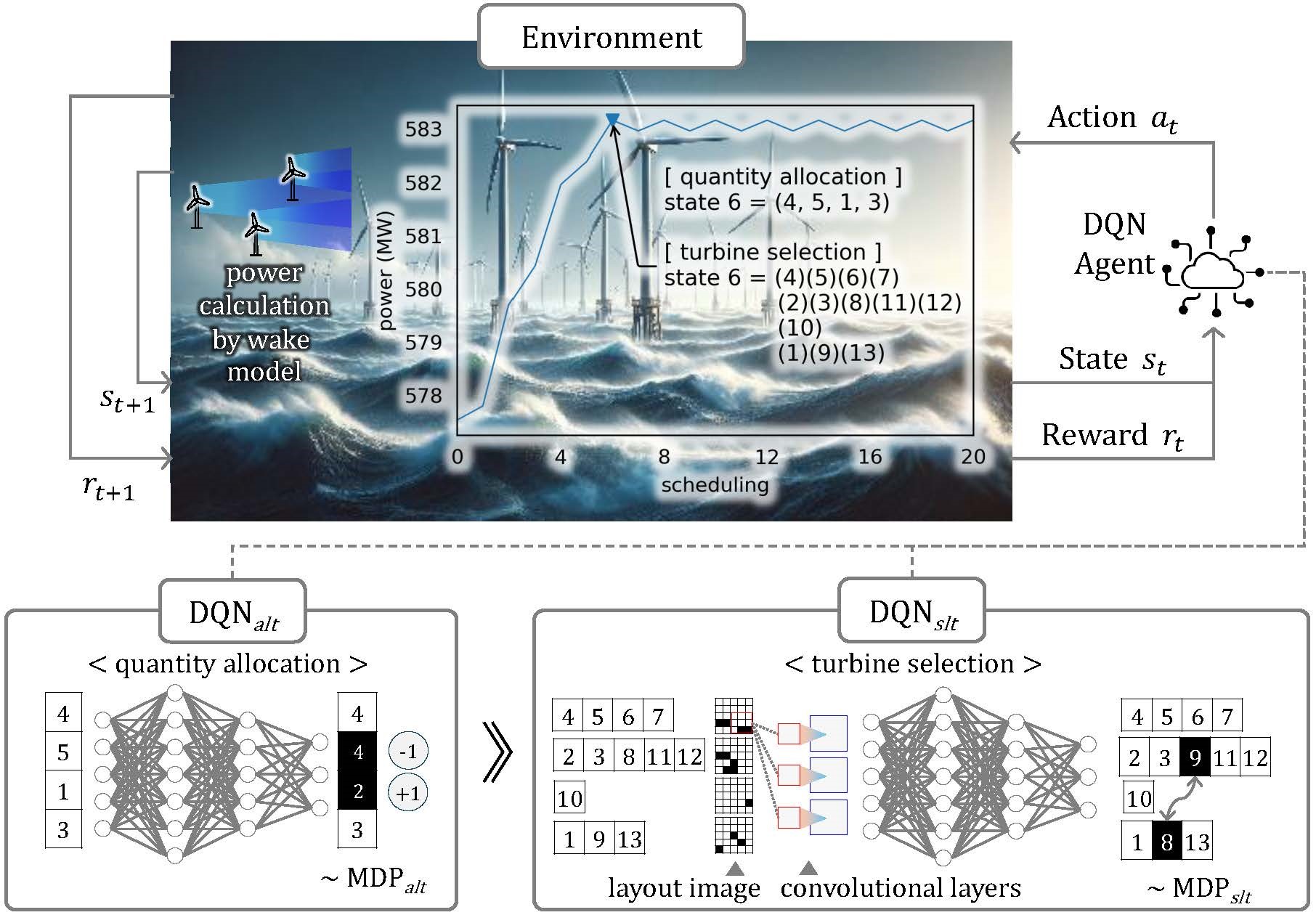
The Smart Convergence Research Institute has developed a technology that employs deep reinforcement learning, a form of deep learning, to optimize the maintenance scheduling of large-scale offshore wind farms.
This technology was spearheaded by Senior Manager Lee Nam-kyung, who is the head of the development team and the lead author of the related scientific paper. This paper was published online on September 11 in Applied Energy (Impact Factor 10.1, top 6.1%), a leading international journal in the field of energy engineering.*
(Joint authors: Professor Woo Joo-hyun of Korea Maritime & Ocean University, Professor Kim Seong-ryeol of the Kumoh National Institute of Technology)
*Title of Paper: A deep reinforcement learning ensemble for maintenance scheduling in offshore wind farms
*Link to Paper: https://doi.org/10.1016/j.apenergy.2024.124431
Wind power plays a crucial role in achieving carbon neutrality, and last year, global wind power capacity surpassed the 1 terawatt (TW) mark. Recently, wind power has emerged as a means of achieving economies of scale. However, in a marine environment, unpredictable waves and weather conditions, along with the reduced wind speeds experienced by turbines located downstream—a phenomenon known as the “wake effect”—present significant challenges for efficient operation and maintenance.
In large wind farms consisting of 100 to 200 turbines, or even 40 to 50 turbines, these factors can result in substantial losses in power output. Therefore, determining which wind turbines to repair and when to carry out these repairs during operations is a complex optimization problem.
To tackle the issue of allocating maintenance tasks for specific periods and selecting which wind turbines to service, the development team devised a Markov Decision Process (MDP) and implemented it using deep reinforcement learning. While MDP primarily focuses on decision-making, the incorporation of deep reinforcement learning enabled the team to generate an optimized maintenance schedule that maximizes power output from offshore wind farms.
When a wind turbine is stopped for maintenance work, the location of the turbine could change the power output of the entire wind farm. Based on this insight, the team was able to improve the maintenance scheduling by adding convolutional layers to the technology with which the operational/non-operational states of turbine generators could be interpreted two dimensionally.
As the patent on this technolgy was approved in April, the team is now relentlessly pursuing its commercialization. The Smart Convergence Research Institute declared that, hereafter, it will keep on working to expand the AI-based carbon-neutrality portfolio in the future.
File
-
 딥러닝 기반 해상풍력단지 정비 스케줄링 기술 개발.png
(350.73KB )
Download
- PrevPromoting the company’s SMR “BANDI” at the 68th IAEA General Conference Technology Exhibition
- NextKEPCO E&C and Unison Join Forces in Wind Power Project Development